Gutschein Gallery
TUSHITA GALLERY MATCHA | JAPANESE TEA CEREMONY
TUSHITA GALLERY MATCHA | JAPANESE TEA CEREMONY
A classic tea ceremony followed by an introduction to the daily preparation of Matcha, the Japanese powdered tea....
A paper gift card in a parchment envelope and a card for a personal greeting to pass on. When purchasing, you choose an individual value and the recipient can redeem the voucher as a single course event, in sequence, or with friends/family.
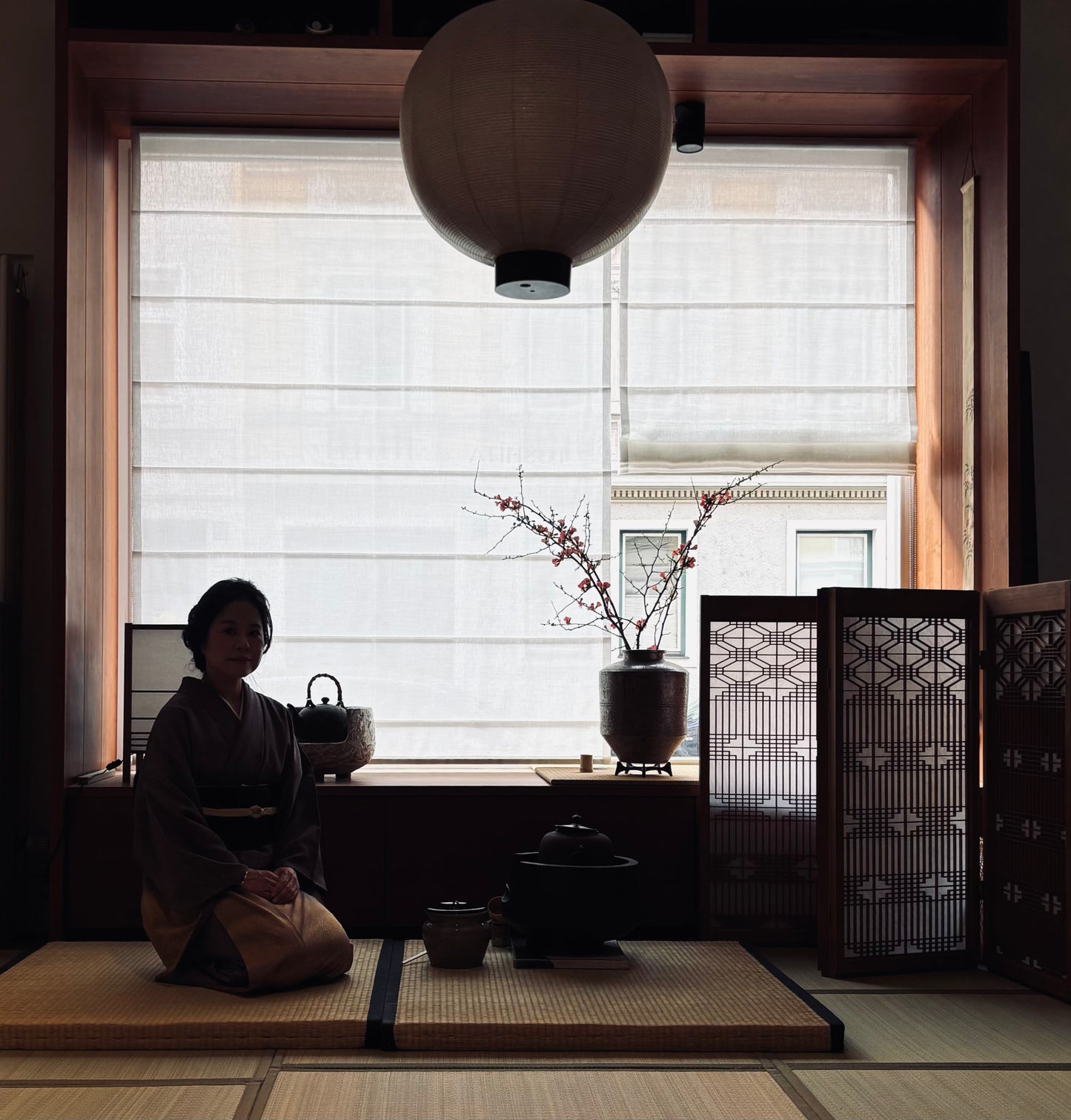
The courses take place in the Tushita Gallery, which is just around the corner from the teahouse. The gallery was designed by Om Hellenkamp specifically for the tea school, events & meditations. Clarity, warmth, and aesthetics inspire visitors to enjoy the moment.
The recipient is asked to send an email to gallery@tushita.eu up to 8 days before the desired event. You can find the dates for the tea school & meditations at events.tushita-gallery.eu
The Tea Ceremony
Anyone interested in Japan and its culture will sooner or later encounter green matcha powder.
Matcha tea has held a firm place in Japanese culture and lifestyle for over a thousand years, having been brought to Japan from China by Buddhist monks in the 8th century.
The tea was and still is very popular among monks because it is an effective anti-sleep aid during long meditation sessions, promotes concentration, and has many positive health properties.
In addition to all these good qualities, which we in the West are increasingly appreciating, the ritual of the tea ceremony, also called Sado or Chado, has inspired generations of people.
This ceremony was developed by the tea master Sen no Rikyu in the 16th century and quickly became an important part of Japanese culture.
His unique legacy was the combination of the philosophy of Wabi Sabi with Ichigo Ichie, which emphasizes the importance of encounters between people.
Every encounter is unique. In relation to the tea ceremony, this means that every tea gathering with its participants can only take place once at this time and in this place and cannot be repeated.
Behind this lies the awareness of transience – an important aspect of spiritual Japanese thought.
He also formulated its four principles: harmony (wa), respect (kei), purity (sei), and tranquility (jaku).
These values, influenced by Zen Buddhism, shape the connection between the participants of the ceremony as well as their attitude towards the tea room and the utensils used.
These concepts derived from the philosophy of Wabi Sabi are reflected in the beauty of the tea room, its tranquility, and harmony.
The simple, mindful movements of the tea teacher, the beauty of the objects used in the ritual, combined with the spirit of the host and that of their guests, create a harmony and contemplative atmosphere that is hard to resist.
Afterwards, the tea teacher shows how to prepare a bowl of matcha at home or in the office. Which utensils are helpful, what quantity of tea, how to hold the tea whisk, and how to clean the tea utensils.
About the Tea Teacher
Aya Poppel was born in Japan in 1978 and grew up in Singapore.
After returning to Japan at the age of 15, Aya attended school in Kobe and studied behavioral science at Kobe College.
Around this time, Aya became acquainted with SADO (Urasenke) and was trained by the tea masters Sōmi Matsuzawa and Sōshi Ueda.
After graduating from university, Aya moved to Tokyo and worked in marketing at Asahi Shimbun, one of Japan's largest newspaper companies.
After working for Asahi Shimbun in Tokyo, Nagoya, and London, she worked part-time as a magazine reporter in Hong Kong.
Since 2020, she has been on parental leave and lives in Munich.
Couldn't load pickup availability
Teilen